
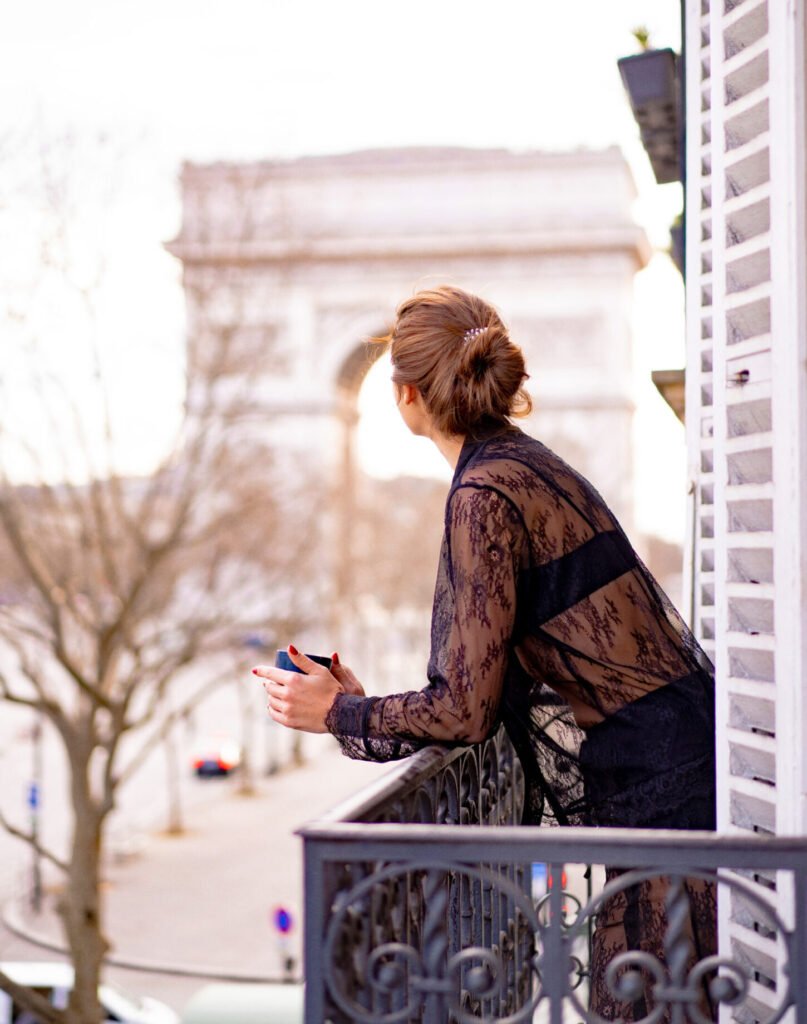
Paris, c’est une ville romantique, chique, et surtout érotique !!
– Dancer at the Moulin Rouge
Do you want to follow in the footsteps of the Marquis de Sade in Paris? Do you want to discover the most erotic city in the world?
On this page you will find places that are linked to D.A.F. de Sade, along with places where you can go erotic.
I.
First things first. When visiting La Ville Lumière you cannot miss the stylish department stores and little boutiques. Before your shopping spree is done, peek in at several lingerie stores offering the most luxurious and finest lingerie en dentelle. Paris is the place to shop for lingerie. There is no better place. Everyone knows that. Even non-French lingerie brands, from the UK and the US, use French names for their brands. Why? Because French is chique et erotique!
Marquis de Sade would have loved to buy loads of naughty lingerie for the women in his life. He definitely would have chosen the chicest of chic places. Why not do as he did and embrace a little luxury? Here are some exquisite lingerie brands that is bought by the upper class:
Aubade – Classical and elegant lingerie collections from Paris.
Agent Provocateur – Really naughty.
Bordelle – This is the chicest erotic lingerie! … Ever! … Bordel !
Cadolle – A pioneer in luxury lingerie for generations (since 1889). Buy ‘the original’ from Paris.
Scandale (Maison Close) – Oh la la …. another true French icon. Makes you want to rewatch Kubrick’s movie Eyes Wide Shut.
Lise Charmel – timeless
But why wait until Paris? Why not buy some erotic lingerie now and start practicing à la paresseuse ?
II.
Now that you are all dressed up and ready to make your erotic dreams come true, you will fly to Paris with Air France. There is no better way to visit France and business travellers should prioritise Air France for their excellent connections and airport lounge access. (They will even serve you champagne). Or go in style: take a VIP flight.
When in Paris, stay at least in one of the top class palace hotels:
Hôtel Lutetia: The best hotel on the Rive Gauche and associated with artists, writers, and philosophers. Across Le Bon Marché, still a go-to destination for purchasing quality lingerie and luxury goods.
Le Meurice: Opposite the Jardin des Tuileries since 1835. Timeless.
Hotel Majestic (The Peninsula Paris): Another splendid Palace de France.
George V: Voted as “Best Hotel in the World” with its Michelin gourmet restaurant Le Cinq.
Plaza Athénée: Do we need to say more?
And if none of those chic hotels strikes you as sensual enough, then stay at the former brothel that has been converted into a five-star hotel:
Maison Souquet: ….. Stepping inside is like entering an erotic novel.
III. La Rive Gauche
After a good night’s sleep, – or not -, there are a few places of interest to visit that are linked to the youth of our esteemed Marquis. We shall therefore remain on la Rive gauche, the left bank of the Seine, the part of the city associated with intellectuals, artists, musicians and singers, students, and the nobility.
First of all, his birth. As is well known, DAF de Sade was born on 2 June 1740 at the Hôtel de Condé, where his mother, Marie-Éléonore de Maillé de Carman, had her apartments, in her capacity as dame d’accompagnement (lady-in-waiting) of the Princess of Condé (Caroline of Hesse-Rheinfels-Rotenburg). Little Donatien was therefore very closely connected to the royal family from a young age, and he played with the young Prince Louis-Joseph de Bourbon, who may well have been his half-brother. Until the age of three he was pampered by the most beautiful maids and surrounded by luxury and abundance, as he himself wrote in Aline et Valcour. Today, nothing remains of it, as the private mansion was demolished in 1779. The mansion and its garden occupied almost the entire plot bounded by Rue de Condé, Rue de Vaugirard, Rue Monsieur-Le-Prince and Carrefour de l’Odéon in the 6th arrondissement. You can still stroll through the narrow streets and, in the evening, pay a visit to the renowned Théâtre de l’Odéon, which was built in 1782 when the Marquis was 42 years old.
From his birthplace, it is just a few steps walk to the church where DAF was baptised: the Église Saint-Sulpice. In this church, whose façade was designed by Servandoni and where Baudelaire was also baptised, there is no longer any trace of the Marquis. However, it is certainly worth a visit, if only because you will find yourself in one of the more upmarket areas of Paris.
Next, head to the Collège Louis-le-Grand, the elite school where Donatien was educated from the age of 10 to 14. Here he was taught by the Jesuits and also received lessons in the art of acting and dramatic literature. The school was, at the time, the most sought-after and most expensive in the capital. Perhaps he was already eyeing up the richest girls in the country whilst he was here.
IV. La Rive Droite
You could spend the following days visiting a few other places and soaking up Parisian life just as DAF would have done. We shall now head to la Rive droite, the right bank of the Seine, the part of the city reputed to be more sophisticated and conservative.
If this is your first time in Paris and France, you can of course also visit the more touristy attractions – he would have done the same – before moving on to the more off-the-beaten-track spots associated with our Marquis de Sade.
We recommend visiting the following specific places:
- Place de Vosges: this beautiful square, built in the 18th century, was where the nobility and members of the royal family gathered. It was a hub of aristocratic life in the 18th century. Place de Vosges, the oldest planned square in Paris, which Sade frequented in his youth, is the place to stroll through the gardens and admire the architecture. It is likely that DAF encountered the following people in the square or in the ‘Pavillon de la Reine‘: Madame de Pompadour, Madame du Barry and Marie-Antoinette. It would be best if you could also stay here for a night, provided it now houses a hotel, or dine at its restaurant Anne.
- A visit to another square a little further on is a must: Place de la Bastille. Nowadays a large square, it used to be the most hated place in France because of its prison. It was here that the Marquis spent years of his life and wrote some of his masterpieces: “Aline et Valcour” and “La Philosophie dans le boudoir“. You can still see the outlines of the demolished prison on the ground, and if you sit on the terrace of Café Français and look out at the square before you, you can imagine the Marquis spending his years there as a threat to the state, amidst murderers, thieves and political prisoners. The fortress stood next to the Saint-Antoine district, the working-class neighbourhood where the revolutionaries were already hatching their plans and biding their time to bring down the monarchy. You can read about how this unfolded in the famous novel A Tale of Two Cities. Set against the backdrop of the French Revolution of 1793, the novel moves between London and Paris as the revolution transforms France. Dickens contrasts the relative stability of London with the turbulence of Paris, creating one of literature’s most famous openings: ‘It was the best of times, it was the worst of times.’ Today the beautiful Parisiennes are strolling by. If only the Marquis knew how they look like and what a variety of beauties there are currently …. Oh la la la!!
- Just round the corner, you can enjoy a delicious meal at one of the renowned bistros Paris has to offer: Bofinger, which is the oldest Alsatian brasserie in Paris. With its dome, wood panelling and seafood, it epitomises the elegance of Parisian brasseries. Although this brasserie didn’t exist back then when de Sade lived – it didn’t open until half a century after DAF’s death – it’s a brilliant place to enjoy French cuisine. Especially the oysters, which, as we all know, are a true aphrodisiac! And if you want to know how to eat oysters properly, read My Uncle Oswald , the erotic comedy novel written by Roald Dahl.
V. Pigalle
When you say ‘eroticism’, you say ‘Paris’. And when you say ‘Paris’, you say ‘Moulin Rouge’!
For years now, the famous dancers of this Parisian cabaret have been kicking their beautiful legs high, setting the hearts of men and women racing. What a show! From the French Cancan to haute couture, from the rooftops of Paris to the world’s greatest stages, a whole philosophy of live performance is revealed. De Sade would be there every night. Because there’s nothing quite like it! It’s one of the few shows that’s entirely visual, accessible to people from all cultures, and universal. The moment you step into the venue – which is already legendary – you’re transported back to the Belle Époque. And it’s a show full of dance, rhythm and a truly festive atmosphere. The most beautiful dancers and muscular male dancers leave an unforgettable impression, all in the most chic manner!
Moulin Rouge is located in the Pigalle district of Paris. Especially the southern part of Pigalle has a scandalous and libertine past, as it was a former historic hub of cabarets and brothels. From the late 19th century onwards, and particularly between the 1910s and 1930s, the Pigalle area and ‘Nouvelle Athènes’ were home to more than 200 brothels – havens of pleasure sheltered from prying eyes -, and a large number of classy nightspots where you could meet renowned courtesans. All that remains now are the can-can shows and sex shops.
If you want a more avant-garde venue, head to the Crazy Horse. There, all sorts of lighting effects, laser projections and meticulous choreography are used to create ‘the art of the nude’.
Or visit La Nouvelle Eve, the cabaret frequented by Parisians themselves, which is set in a smaller, more intimate venue.
VI. Boire et manger à la française !
It is common knowledge that Lyon is the gastronomic capital of France, and perhaps even of the world, but Paris certainly comes a close second. In Paris, you can certainly lose yourself in the delights and delicacies on offer, and enjoy a meal in one of the capital’s many restaurants and bistros. The vast majority of these, however, are no more than 100–150 years old. If you’d prefer to stay true to the style of the 18th century or the Napoleonic era – the time when our marquis lived – we recommend dining at one of the following restaurants, which were already in existence during the marquis’s lifetime. There are four on the Left Bank and four on the Right Bank, where you are expected to dine in style:
Rive gauche:
- La Tour d’Argent: Perched on the banks of the Seine opposite Notre-Dame de Paris, La Tour d’Argent is a long-standing Parisian institution that has been blending legend and fine dining for several centuries. The history of this establishment is as much a matter of archived records as it is of stories passed down through the generations, and every corner of its dining rooms tells a story of Paris. Since the 16th century, this restaurant – frequented by heads of state and celebrities – has overlooked the river in a setting rich in tradition and symbolism. Discover its history and its exceptional views.
- Lapérouse: Since 1766, Lapérouse has been setting the heart of Paris alight. Located in the 6th arrondissement, this restaurant embodies the refinement of French gastronomy, the sensuality of its private dining rooms and the vibrant history of Parisian high society. One of the first restaurants to be awarded three Michelin stars in 1933, Lapérouse has been a living legend, blending literary heritage, sensual pleasures and the French art of living.
- Le Procope: Right in the heart of Saint-Germain-des-Prés, Le Procope stands as a living monument to Parisian history. Founded in 1686, this legendary restaurant in the 6th arrondissement is the oldest café in Paris still in business, a haunt for writers, thinkers, revolutionaries and gourmets. Voltaire, Rousseau, Diderot, d’Alembert and Beaumarchais would debate there over a steaming cup of coffee. It has stood the test of time without losing its soul.
- La Petite Chaise: Tucked away on Rue de Grenelle in the 7th arrondissement, La Petite Chaise embodies an entire chapter of Parisian culinary history. Opened in 1680, this unique establishment proudly claims the title of Paris’s oldest restaurant, having been in continuous operation for over three centuries. A historic gem that blends bourgeois gastronomy, royal anecdotes and literary memories.
Rive droite:
- Au Rocher de Cancale: Since its founding in 1804 this historic restaurant has become an iconic landmark on Rue Montorgueil, a neighbourhood historically linked to the trade in fresh fish from the coasts of Normandy and Picardy. Le Rocher de Cancale, with its specialities of fried oysters or oysters served ‘in the shell’, quickly caught the attention of Parisian society, becoming an unmissable after-theatre destination.
- Le Grand Véfour: Since 1784, Le Grand Véfour has epitomised French culinary excellence in a refined setting nestled beneath the arcades of the Palais-Royal. This legendary restaurant is one of the oldest still in business in Paris, and certainly one of the most prestigious.
- La Mère Catherine: Perched in the heart of Montmartre, on the famous Place du Tertre, La Mère Catherine proudly claims its status as one of the oldest restaurants in Paris still in business. Founded in 1793, this establishment epitomises the spirit of old Montmartre: a warm, welcoming atmosphere, traditional French cuisine and an artistic ambience.
- Le Pavillon Ledoyen: Nestled in the heart of the tree-lined Champs-Élysées, the Pavillon Ledoyen is a Parisian gastronomic landmark, bearing witness to over two centuries of history and now embodying contemporary haute cuisine under the guidance of chef Yannick Alléno. Behind its unassuming façade, this 18th-century pavilion is home to one of the capital’s most prestigious restaurants. It houses actually three restaurants, each with Michelin stars, and people have been dining in the pavilion since 1792.
VII. … L’amour à la française …
Paris has never been just the city of love!
It is also the city of desire, of sensual warmth, of lingering glances and of places where the night seems to pulsate to a different rhythm.